The Hidden Artistry of Afghan Girls
In Afghanistan, silence is not just an absence of sound, it is a way of life. Pressed into us from childhood, it lives in our homes, where from an early age, girls are taught to lower their voices, and to measure every word before it leaves their lips. It lives in the streets, where a glance too bold or a laugh too loud can be dangerous. It lives in our friendships, where we cut stories short, unsure of who might overhear.
This silence is not only about schools being closed, though that wound is sharp and undeniable. It is also the silence of conversations left unfinished, dreams folded away, songs that never leave the throat. It is the silence of girls walking down streets with eyes lowered, hiding their emotions to stay unseen. The weight of silence is everywhere, always pressing on us.
Yet, silence can also become a place where something else is born. In the absence of words, we build inner worlds. In the quiet moments, we can listen to our own thoughts more carefully. Though imposed on us, silence becomes a paradox: a prison, but also a canvas. And from it, our quiet rebellions begin.
Quiet Rebellions
When I was a child, I didn’t know why drawing a flower in the corner of my notebook mattered so much. Or why adding a mustache to a king’s portrait in my history book made me smile even when everything else felt heavy. Back then, doodling wasn’t encouraged — it was something that was forbidden, as if imagination had no place in the margins. But those little drawings were my quiet acts of freedom, my way of leaving a trace of myself in a world that often wanted me silent. Now I see they weren’t meaningless at all; they were my first rebellions against invisibility.
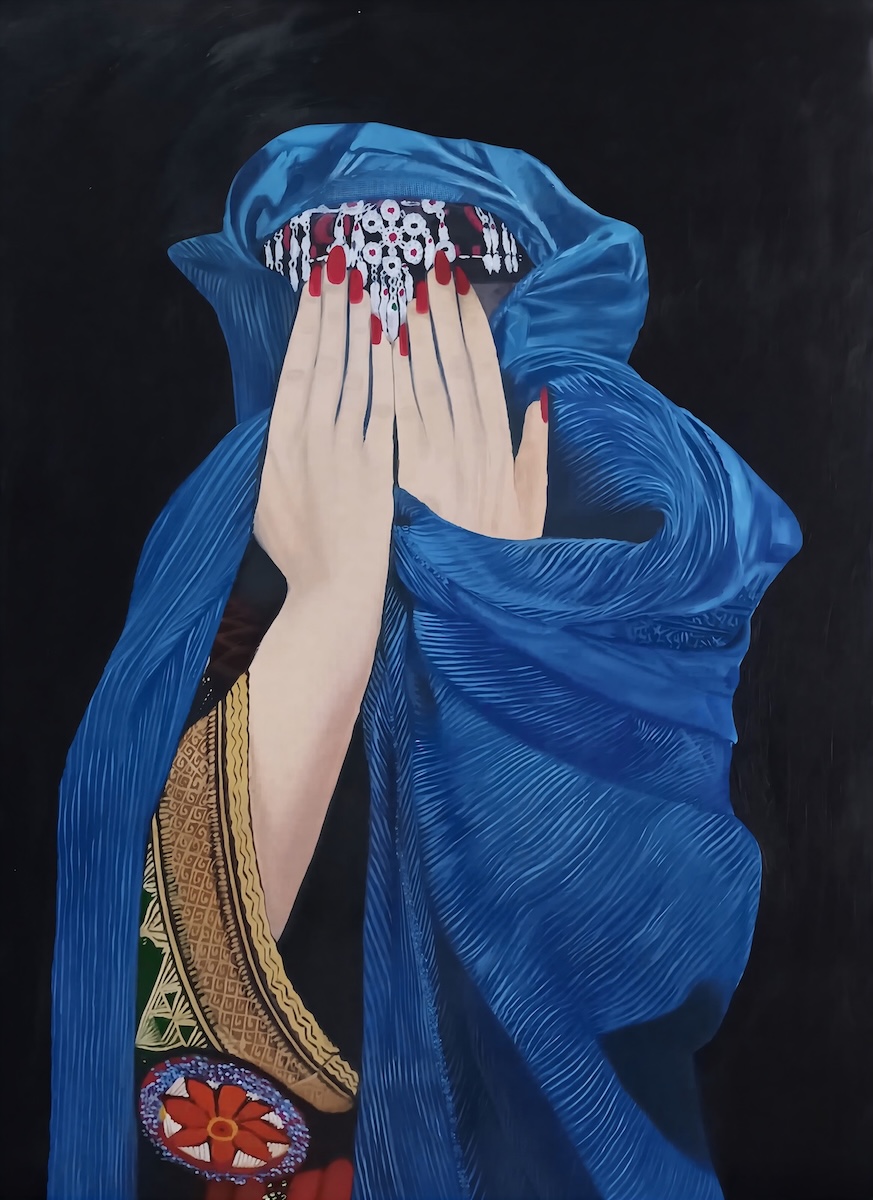
Even today, when the notebooks stay shut and the classrooms remain locked, these rebellions continue. They take different forms now. A girl hums a forbidden song quietly under her breath as she sweeps the courtyard. Another paints her nails a shade of red and hides them under her sleeves, knowing the color is a secret only she will see. Another braids her own hair in a way she knows will never be seen beyond her walls, but she pauses to admire it in the quiet of her room.
Each act seems small to others, but to us, they are lifelines. A doodle. A song. A splash of color hidden beneath black cloth. They are proof that no matter how much silence surrounds us, the human spirit insists on expression. We may not be allowed to speak loudly, but our quiet rebellions shout in their own language.
Faith as Our Only Art
My grandmother never went to school, but she carried faith as her language. Every dawn she whispered prayers into the stillness, her hands moving slowly across a string of beads. Watching her, I learned that silence can be more than emptiness, it can be a rhythm, a way of holding strength when the world refuses to give you any.
For Afghan women, faith has always been about more than belief; it has been about survival. When the world changed — when the Taliban’s return took away classrooms, libraries, and galleries — faith became the only space left to reflect, to breathe, to heal. In her silence, my grandmother created an art that was invisible but lasting, an art of perseverance.
I carry that same inheritance now. Not because I chose it, but because in the absence of freedom, faith is what remains. A whispered verse, a quiet breath, a pause in the noise, these are not luxuries. They are our survival. We survive by holding on to what cannot be taken: our prayers, our stories, our hope. That is how Afghan girls, like me, have turned silence into something more than despair.
The Art We Lost
Afghanistan was not always this way. Our land once bloomed with art, music, and poetry. From the miniature paintings of Herat to the great Buddhas of Bamiyan carved into the cliffs, creativity was once part of our culture, part of the very air we breathed. Growing up, I saw pictures of those Buddhas in my schoolbooks, their faces serene, and I thought I would one day stand before them. By the time I was old enough, they were gone, destroyed by the Taliban — another piece of beauty erased because of fear.
It was not only stone that was destroyed — a part of us was erased too: the reminder that we come from a long lineage of beauty, stillness, and reflection. Our textbooks now carry fewer pictures, our homes fewer colors, our lives fewer chances to see the art of our past. Even music has been silenced, instruments put away in attics, and songs reduced to whispers.
And yet, something survives. Even in ruins, the Buddhas still teach us stillness. Even in exile, Afghan poets continue to write. And even in silence, Afghan girls still sketch in secret, hum lullabies to themselves, braid color into hidden fabrics. The art is never fully gone. Because It lives in us.
The Secret Lives of Girls
When people speak about Afghan girls, the conversation often begins and ends with what we cannot do — the restrictions, the closed schools, the limited movement, the silenced voices. All of this is real. But what is less known are the quiet practices that help us endure: art, writing, and meditation. These are not luxuries; they are lifelines, spaces where we can still learn, express, and breathe freely.
Art offers a language beyond words. When classrooms and public spaces are taken from us, creativity becomes a refuge, a way to express thoughts and emotions that might otherwise stay locked inside. A small sketch in the corner of a notebook, a pattern traced on fabric, or even arranging objects in a meaningful way reminds us that we are still capable of creation. Art preserves individuality and imagination in a country that has limited both.
Writing provides another kind of freedom. Through journals, short stories, or poems, we organize our thoughts, reflect on experiences, and explore questions too risky to speak aloud. Writing is not just a pastime; it is a private rebellion, a way to record our presence, our perspective, and our resilience.
Meditation, whether through prayer, quiet reflection, or simple stillness, allows us to breathe in the midst of uncertainty. It restores balance when life feels heavy and strengthens patience when freedom feels far away. It is a quiet form of resistance, a personal refuge that belongs entirely to the girl who claims it.
Everything shifted for me when Voices Unveiled — who are dedicated to empowering women and girls in Afghanistan and neighboring countries through online education, mental health support, and empowerment programs — entered my world.
For the first time, I was given permission not just to learn, but to express myself. They handed me a journal, and instead of lessons written by someone else, I filled its pages with myself. At first, my words were hesitant — half-formed sentences, scattered thoughts. But slowly, the journal became more than paper; it became a mirror, a friend, a classroom, and even a space for meditation.
Through writing, I poured my emotions into words, turning silence into sentences. Some days my entries became prayers; other days, stories or reflections. Alongside writing, I practiced stillness, focusing on my breath or simply noticing the world around me. It wasn’t about escape; it was about grounding myself, finding calm, and listening to my own voice.
Through these small, quiet acts — a word, a breath, a page — I learned that even in a world that locks doors and silences voices, no one can take these away from me. On that page, and in that stillness, I am free. I am loud. I am alive.
Becoming the Art
For so long, I thought I was waiting to see the art of my country, the Buddhas, the paintings, the libraries, the classrooms. But now I understand: I am the art. We all are. Every Afghan girl who continues to breathe, create, write, and survive is living proof that beauty cannot be erased
We are shaped by silence, by loss, by fear, but also by resilience, creativity, and faith. We carry within us the Buddhas’ stillness, the colors of the paintings, the depth of the Afghan poets who have come before us. We may be denied the chance to study them, but we are their legacy.
We are not just the daughters of survival. We are the daughters of art, of beauty, of strength. And even when the world tries to close every door, we hold them open. Because we are still breathing. And in Afghanistan, even breathing is a quiet act of rebellion.
Voices Unveiled reminds me that Afghan women are more than survivors; they are artists, writers, and storytellers of a nation’s rebirth. Their creativity is not just self-expression; it is resistance, identity, and hope.
To listen to their voices is to honor the power of art in the face of oppression. It is to recognize that even in silence, Afghan girls continue to shape the story of their country one word, one color, one breath at a time.
- *Khorshid, age 18, Afghanistan
Note: *Not her real name. All names have been changed to protect identities.